Wet contact can capture some pollutants.
Properly designed scrubbers can collect particulate matter and soluble gases. Greater collection often brings greater energy use or pressure drop.
Open vehicle-emissions concept · P—28
A proposed bolt-on wet-scrubbing and sampling module for the end of an existing vehicle exhaust. It asks whether a low-resistance mist stage could collect additional particles and water-soluble compounds without defeating the approved catalyst, particulate filter or engine.
It has not yet been built, tested, certified or approved for road use. This page publishes the idea as a falsifiable engineering question—not a pollution-reduction result.
Do not fit this concept to a vehicle, run an engine in an enclosed space or treat the illustrated capture percentages as achieved performance. Testing must preserve approved emissions equipment and stay within engine-manufacturer back-pressure and temperature limits.
The engineering question
Wet scrubbers are established industrial control technology. Their performance depends on particle size, gas–liquid contact, contaminant solubility, liquid-to-gas ratio and energy input. A compact, mobile, freeze-tolerant and low-back-pressure version is a separate problem that must earn its claims through measurement.
The captured pollution does not disappear: it moves into water and deposits that may require hazardous-waste analysis and controlled disposal. A useful result must therefore measure both the exhaust and the liquid.
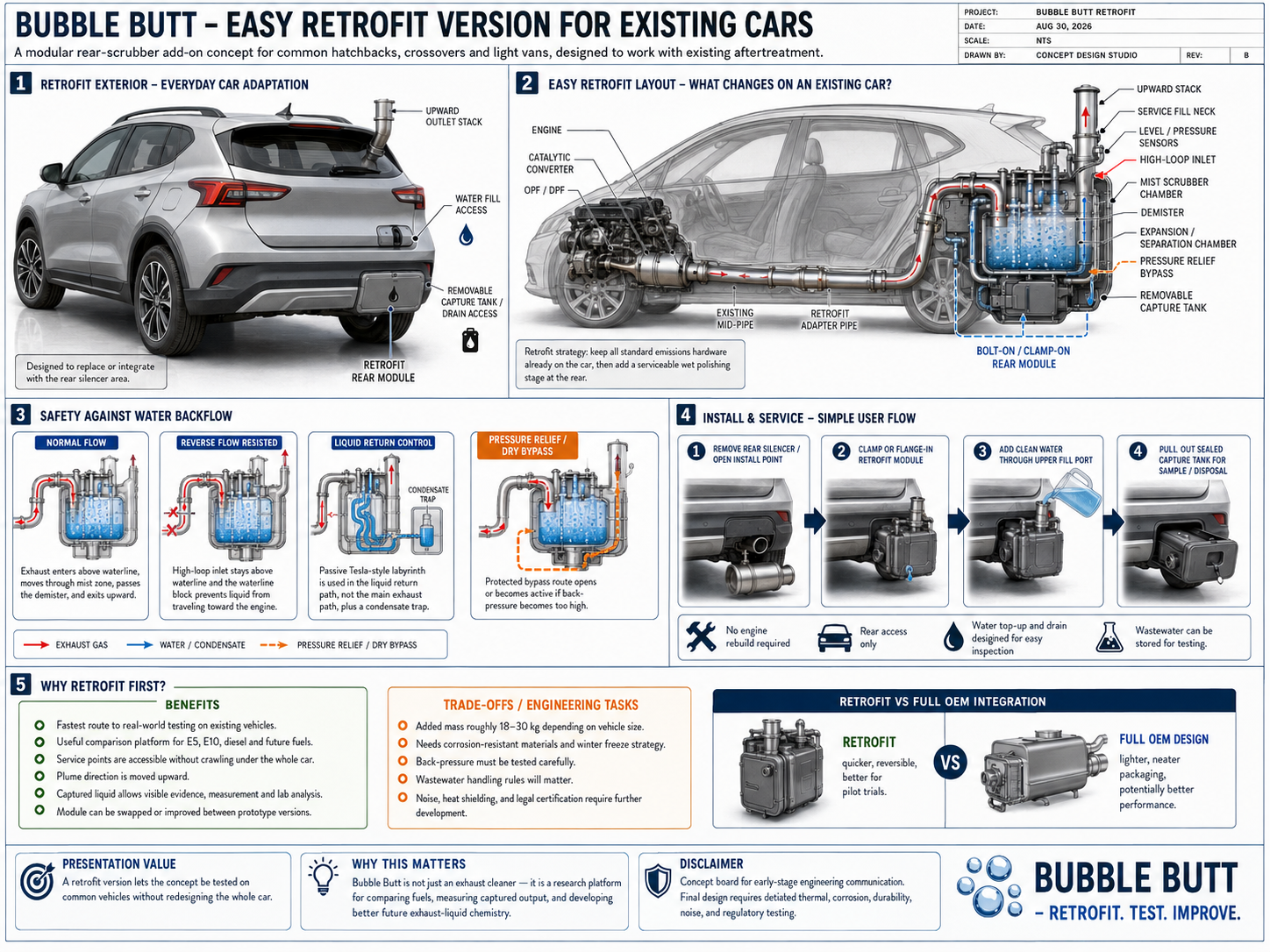
A proposed rear bolt-on module with high-loop inlet, mist chamber, demister, separation volume, dry pressure bypass and removable capture tank. Open full resolution ↗
Properly designed scrubbers can collect particulate matter and soluble gases. Greater collection often brings greater energy use or pressure drop.
The diagrams propose geometry and safeguards. Only controlled measurements can show whether capture is meaningful, repeatable and compatible with a real vehicle.
Plain water does not materially remove most carbon dioxide, carbon monoxide or nitric oxide. It must not replace a catalyst, DPF, OPF, SCR system or lawful maintenance.
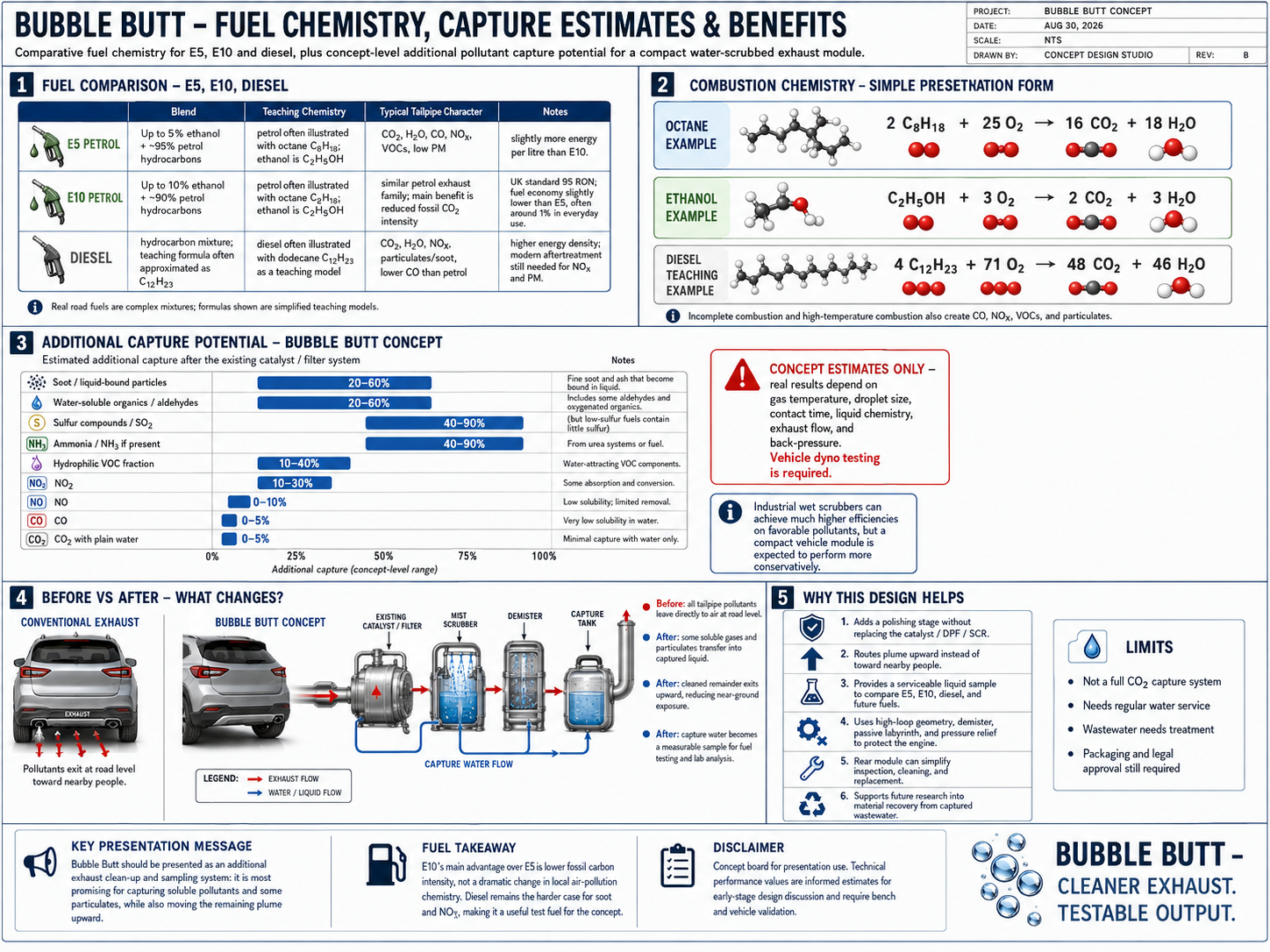
The illustrated ranges are hypotheses for test design—not measured efficiency. Vehicle dynamometer testing and liquid analysis are required. Open full resolution ↗
Protect the engine first
Keep the exhaust entry above the maximum liquid level in every expected vehicle attitude.
Drain condensate and captured liquid away from the gas inlet; test slosh and tilt before heat.
Fail open if restriction rises. The bypass itself must be measured, inspected and independent of the water circuit.
Measure pressure, temperature and level, and prevent droplets leaving the outlet or reaching existing after-treatment.
A staged route from idea to evidence
Engine, after-treatment, fluid, materials and regulatory specialists challenge the flow path, failure modes and measurement plan before hardware is connected.
Use controlled clean air—not an engine—to observe pressure drop, mist carry-over, slosh, drainage, leakage and upstream liquid migration.
Only after Gate 1 passes, measure temperature, corrosion, condensate, relief operation and demister behaviour in an appropriately equipped facility.
Compare an approved baseline, a dry control and the active wet module while measuring regulated pollutants, particle size, back-pressure, fuel use and wastewater composition.
Repeat across load and temperature, dismantle the module, inspect the existing catalyst and filters, publish PASS, FAIL or INVALID TEST, and seek approval before any road use.
What must be measured
Stop conditions
Stop immediately if liquid migrates upstream; pressure or temperature exceeds the approved limit; a leak, mount, bypass or demister fails; combustion or diagnostics become unstable; visible carry-over appears; or instrumentation cannot support a trustworthy comparison.
Every frozen safety and performance threshold passes repeatedly.
A threshold is missed. Publish the result and change or stop the design.
The protocol or instruments failed, so no performance conclusion is justified.
The pollution has changed address
Soot, metals, oils and soluble exhaust compounds may make the tank contents hazardous. Do not pour test liquid into a surface drain, onto land or into ordinary waste. Characterise it, contain it and use an authorised waste route.
This transfer must be included in any life-cycle assessment. A lower tailpipe measurement is not a public benefit if contaminated water, extra fuel use, unsafe pressure or shortened equipment life creates a larger harm elsewhere.
Starting evidence + approval boundaries
Open invitation
The Green Tank welcomes failure-mode review, safer geometries, test capacity and evidence that disproves as well as supports the idea. Friendship with evidence means allowing a useful concept to improve—and allowing an unsafe one to stop.
Offer evidence or collaboration ↗