Learning tool · social technology · P—33
Monkey
Banana.
A very serious investigation into bananas.
Begin the investigation ↓Maybe banana works the same way.
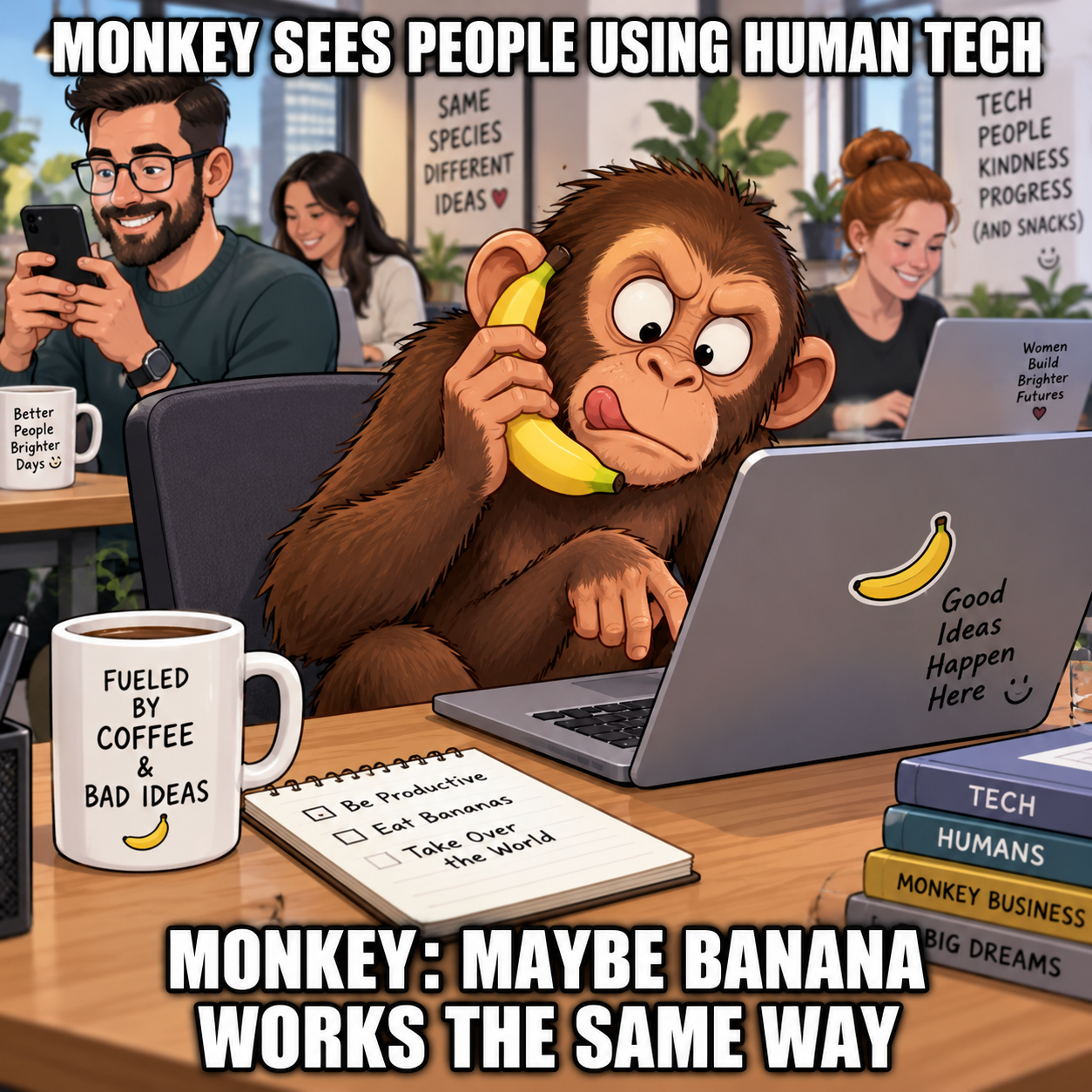
Opening meme · Monkey studies the humans
Maybe banana works the same way.
The monkey’s interpretation is understandable. It has observed an action and found a familiar object with a roughly similar shape. That still does not make the interpretation correct.
“For me?” · “Open it?” · “What is this?”
We don’t know yet.The object may be familiar. The intention may not be. Receiving a signal is not the same as knowing exactly what it means.
Check your banana
Not everything called a banana is a banana.
Tap or click any card to compare the name with what the thing actually is.
Visual interruption
⚠Not to be confused with
Monkey Bandana.
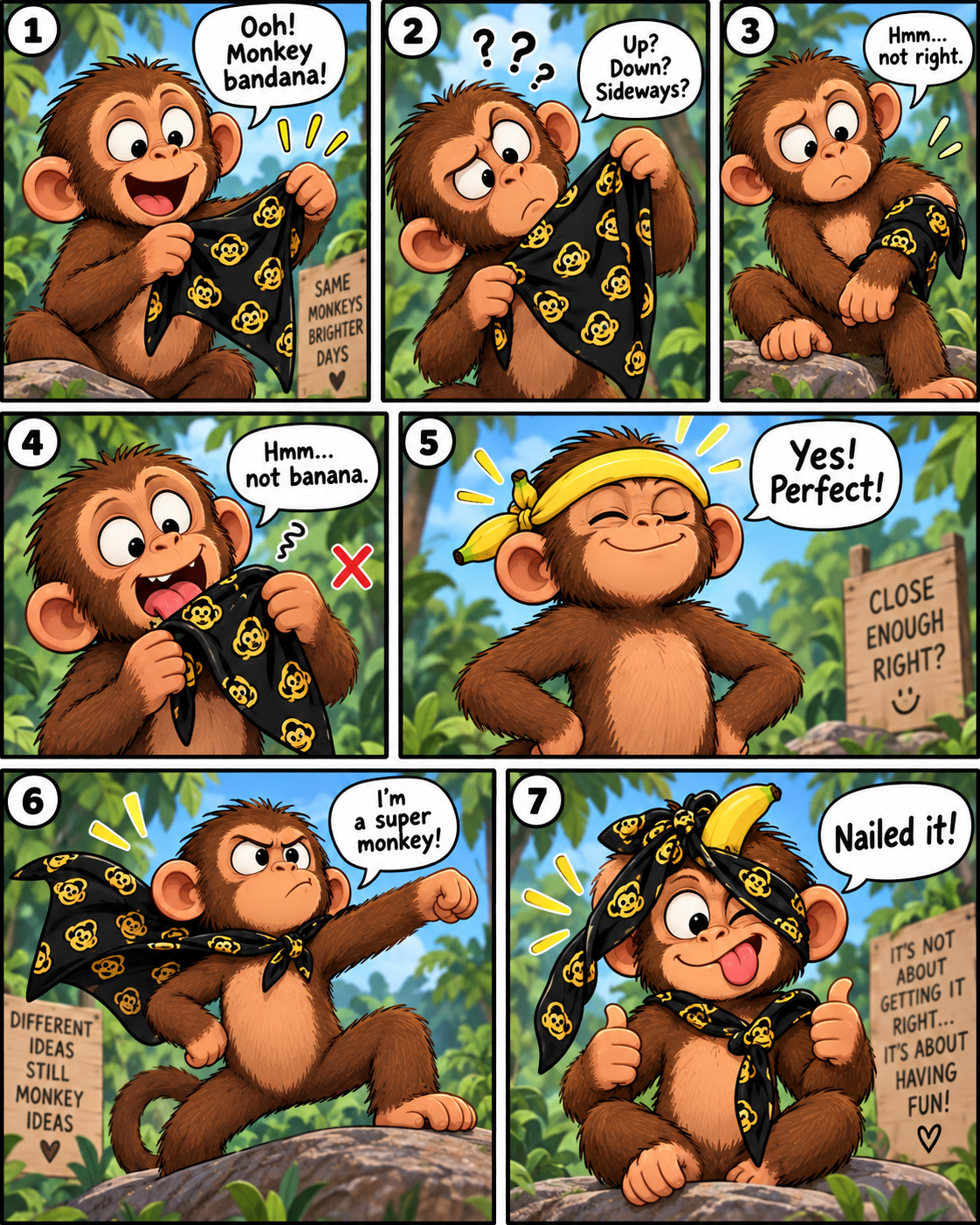
Monkey?
No. Fashion.
Wearing a monkey bandana does not make you a monkey.
Someone else’s interpretation of you may change how they behave toward you. Repeated treatment can even influence how you learn to behave.
But a label is information. It is not ownership. You remain what you are, and you remain free to decide which descriptions you accept.
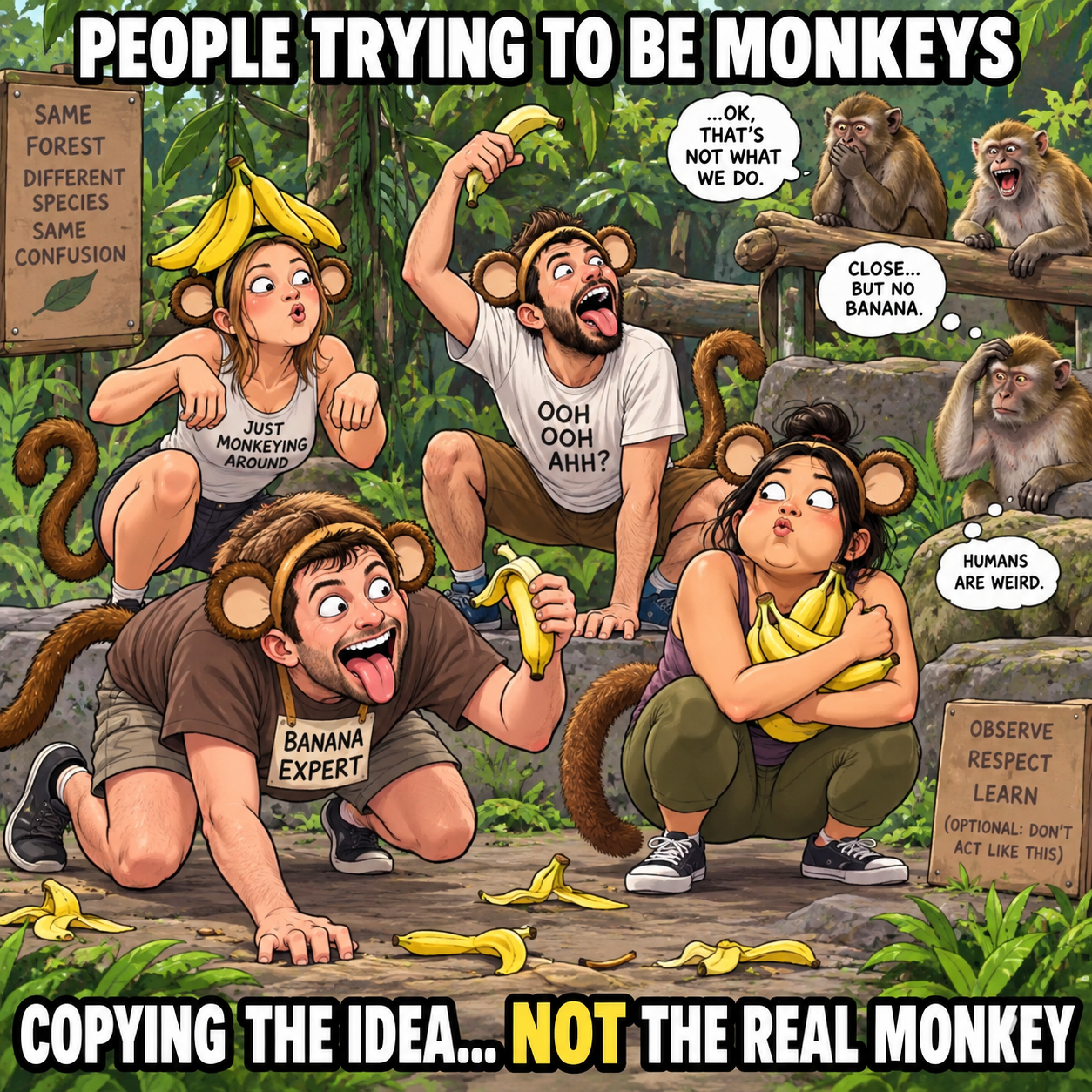
Scene 02 · The reverse error
People trying to be monkeys.
We can observe something, build a simplified idea of it, and then imitate our idea rather than the thing itself.
This can happen when we interpret animals, people, cultures, professions, technologies, religions or political groups. Monkey Banana does not choose the application for you. It offers the mechanism so you can recognise it elsewhere.
Completely unverified monkey intelligence report
What the monkeys let us see.
The monkeys doing silly things outside may really be doing silly things. That observation does not prove that monkeys only do silly things.
What you observe may be real without being complete.
Absence from your observation ≠ absence from reality.
The laboratory and space programme shown here are fictional comic devices. Their function is to keep incomplete knowledge visible—not to make a factual claim about monkeys.
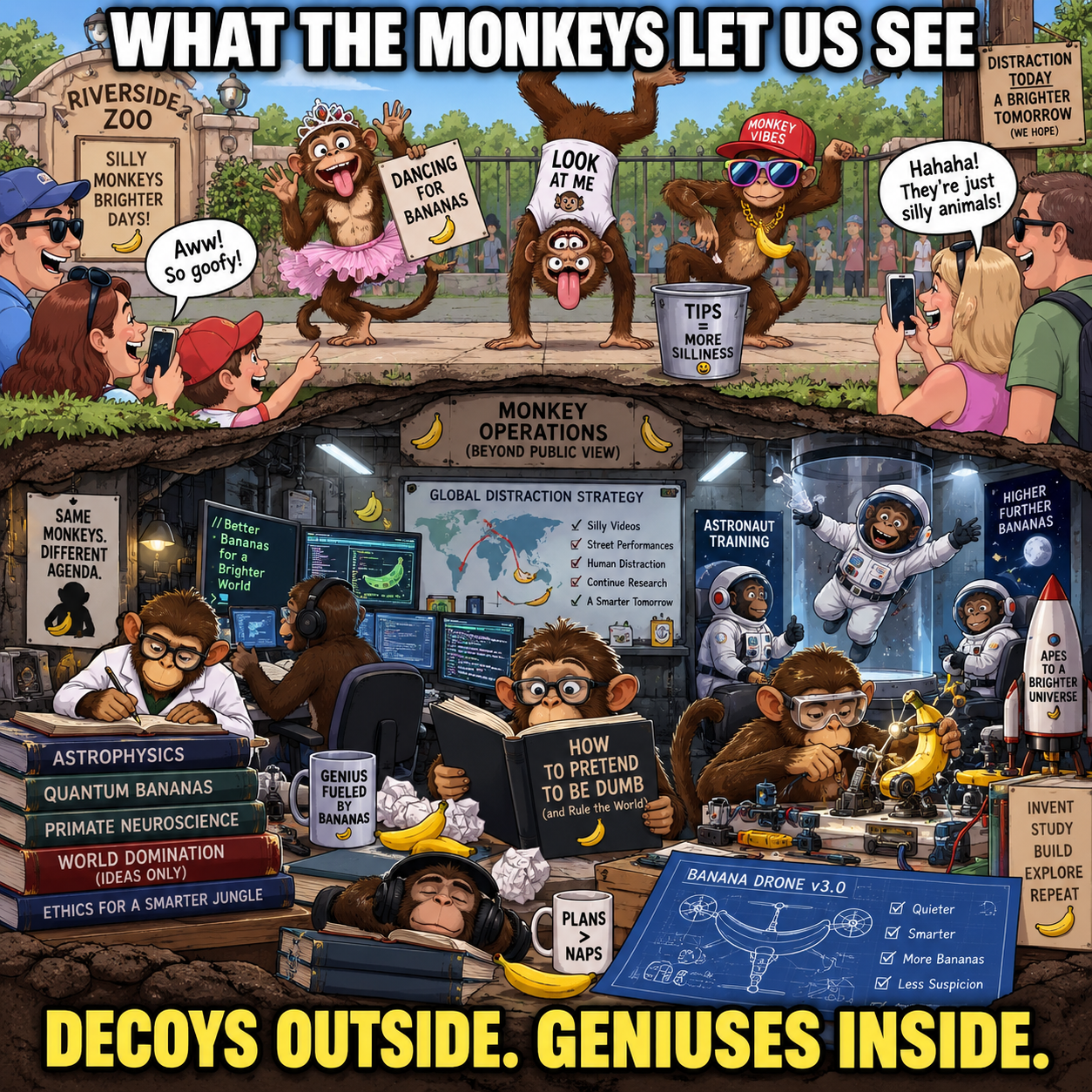
The complete visual thought experiment
One page.
Several bananas.
The original visual board is preserved as a single image so its publishing notes, cross-links, jokes and full sequence remain visible together.
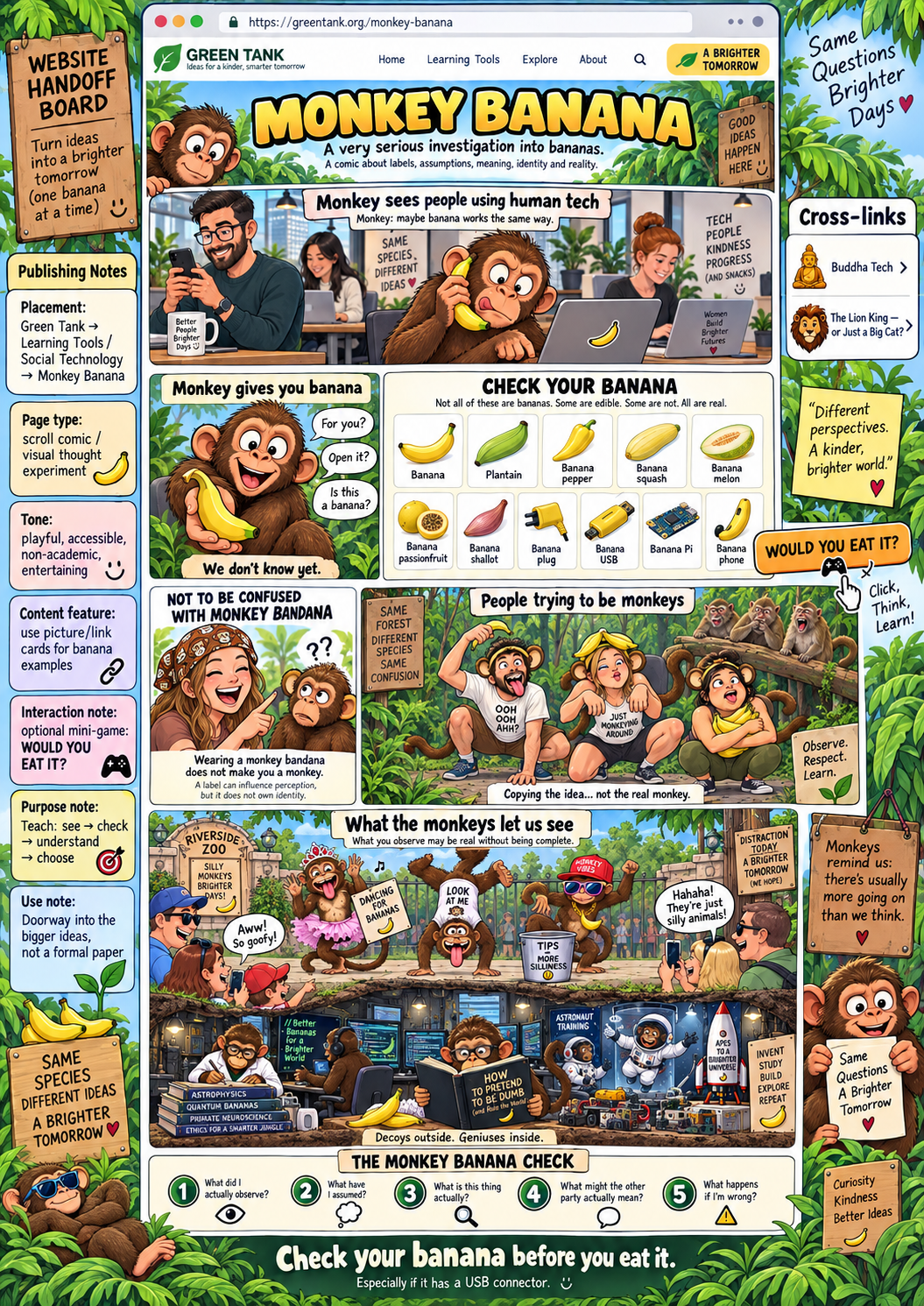
The Monkey Banana Check
Five questions before the bite.
- 01What did I actually observe?
- 02What have I assumed?
- 03What is this thing actually?
- 04What might the other party actually mean?
- 05What happens if I’m wrong?
Check your banana before you eat it.Especially if it has a USB connector.
Why it belongs here
Notice the relationship yourself.
A paper usually says: Here is an argument. Monkey Banana says: Here is something strange. Have a look.
That places it beside The Lion King — or Just a Big Cat? in the Green Tank’s social-technology collection. Both begin with observation, keep assumption separate from evidence, respect the other living thing, and leave room for what has not yet been understood.
It is a visual thought experiment, not a formal research paper. The humour is part of the method: it gives the reader enough structure to discover the relationship without demanding a particular conclusion.
Continue to The Lion King? →Five supplied visual files