Use less and lose less
Find leaks, use water-saving fittings and keep suitable non-drinking water on an appropriately separated route. Reducing demand changes the size of every supply option that follows.
P—55 · Climate Change Technology · water resilience
This study brings low-energy water capture, solar desalination, treatment, storage, and measured recovery into one decision. It compares technologies from a few litres a day through a proposed emergency service for 8,000 people.
Other countries can use the same questions to choose their own mix. Rainfall, seawater, climate hazards, health rules, suppliers and costs must be checked again for each place.
Explore the technologies ↓One place, several water sources
The study begins with Guadeloupe’s uneven rainfall and exposure to dry periods and cyclones. A single device cannot answer all of that. Roofs, fog-prone slopes, sunlight and seawater offer different opportunities, at different scales and with different treatment needs.
Its proposal is layered: reduce avoidable demand; collect and store useful rain; measure fog; test passive devices for households; keep portable emergency equipment; and tender a modular solar seawater system for dependable bulk output. Only the parts that perform under local conditions should grow.
Nine routes in one report
These options do different jobs. The report ranks them by output, energy, maturity, treatment and site suitability; it does not present every option as equal bulk supply.
Find leaks, use water-saving fittings and keep suitable non-drinking water on an appropriately separated route. Reducing demand changes the size of every supply option that follows.
Existing roofs can feed screened, protected tanks. Annual rainfall alone cannot answer a dry-season question; storage, first flush, treatment and intended use determine the system.
Wind-driven droplets can condense on mesh and drain by gravity. Test windward sites through the dry season, record water quality, and make the collector safe to lower ahead of a cyclone.
Radiative surfaces can gather some water at night. The report treats passive dew as a useful small-scale technology, not an unmeasured source for thousands of people.
The locally buildable GWS-1 still is compared with an assembled solar still. Its litres per day, cleaning and water quality need a field test; thousands of modules would be needed for bulk service.
Manual reverse-osmosis kits and small DC units can support clinics, response teams and isolated sites when larger systems fail or cannot reach them.
Modular solar seawater reverse osmosis with pressure-energy recovery is the study’s proposed dependable supply route for the 8,000-person emergency case, subject to intake, brine, treatment and site acceptance.
Compressor and sorbent atmospheric-water devices are examined. Their energy and heat needs make them a different choice from seawater RO where seawater is accessible; use may still be justified for a specific point of need.
Pressure exchange is an immediate efficiency measure. Heat reuse, membrane distillation, extra water from concentrate and mineral recovery need separate chemistry, energy, disposal and product tests.
Also examined: cloud seeding. It can only attempt to influence suitable existing clouds. The study excludes it from committed water supply and keeps the evidence and environmental questions separate from rain capture and desalination.
The original Guadeloupe design · GWS-1
The original GWS-1 is a repairable one-square-metre basin-still field prototype designed for local manufacture. Sunlight warms a shallow layer of seawater; vapour condenses under removable glass and drains into a separate product-water gutter. The design specifies no electricity, pump or pressurised boiler.
The six-page document preserves the dimensions, materials, hand-build sequence, cleaning and storm procedure, 30-day acceptance test and field log.
Field prototype status. The output range is a design expectation, not a measured result. The completed device, product water and storage route need laboratory chemical and microbiological testing before potable use. The PDF sets out those acceptance conditions and keeps trials in a separate labelled collection container.
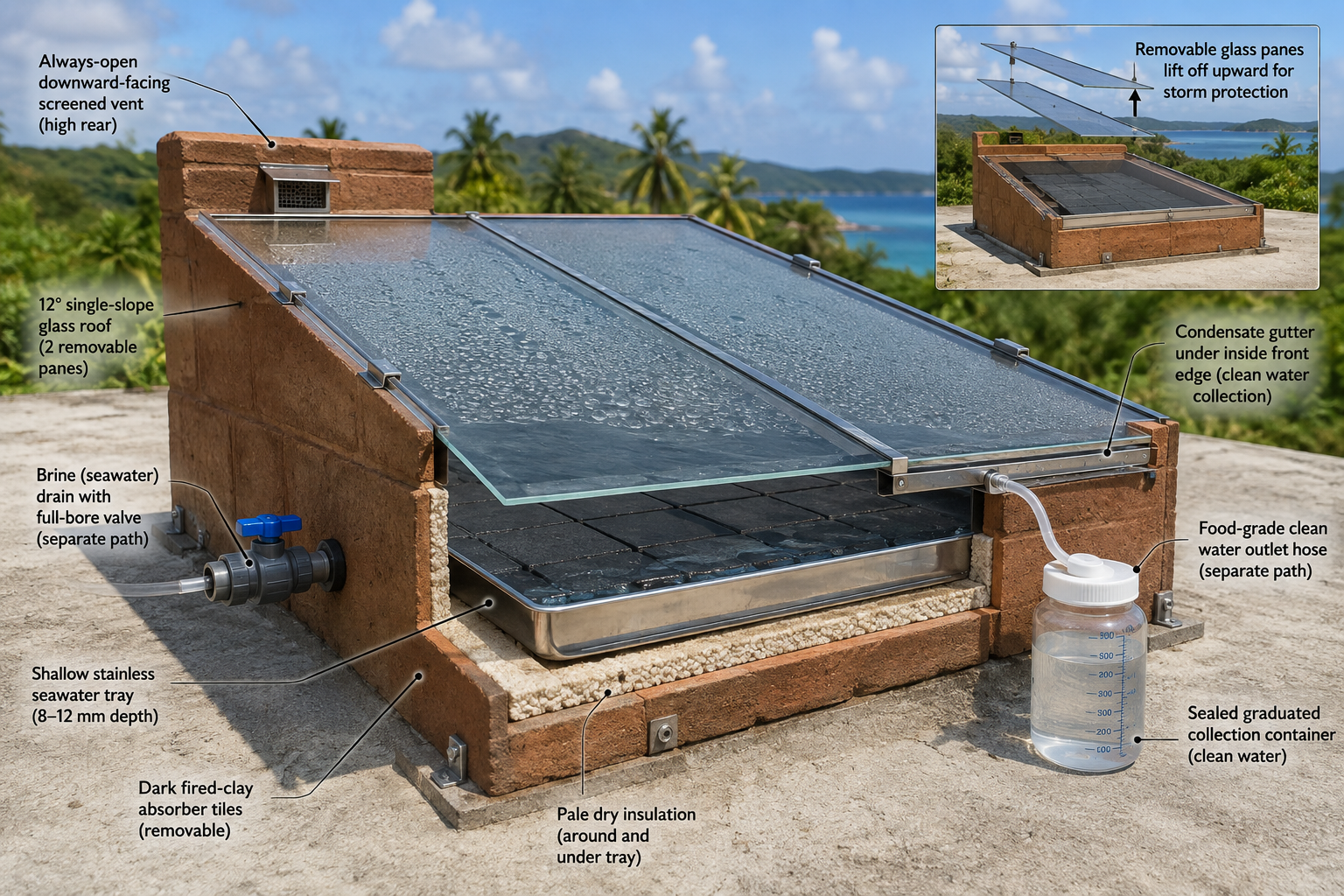
The Guadeloupe design exercise
For 8,000 people at an emergency planning level of 15 litres each per day, the study models 120 m³/day. It proposes two working seawater RO trains and one standby in a three-train configuration, or an equivalent N+1 design.
The paper uses roughly 90 kWp of solar PV as a first-pass sizing basis. Intake, auxiliaries, weather, losses, potable finishing, marine discharge and operator capacity must be resolved in the actual tender. It also compares smaller packages and future expansion without treating them as one universal plant.
What “reflux” means here
REFLUX IT is a controlled set of recovery loops, with a named contaminant boundary and a final reject route. Recirculation does not make salt, pollutants or energy demand disappear.
Recover pressure from RO concentrate into the incoming feed; measure the actual whole-plant energy saving.
Test useful low-grade heat routes without taking membranes or stored water outside their safe conditions.
Return only validated rinse or backwash streams to an appropriate earlier stage; isolate chemical and microbial hazards.
Use treated water in safe tanks to carry a daytime solar output into night demand, with turnover and disinfectant control.
Study extra water or separated minerals only with a fixed concentration limit, contaminant analysis, a legal outlet and a credible energy balance.
Specify repairable parts and local fabrication where suitable, while keeping potable-contact materials compliant.
Adaptation beyond Guadeloupe
Choose the people served and the service level. A drinking-only volume, emergency basic service and normal domestic service require different systems.
Measure rainfall timing, fog, humidity, seawater or groundwater, available energy, hazards, land, maintenance skills and lawful discharge routes.
Use matched weather and water-quality logs; compare local passive capture, a purchased benchmark and powered supply over the season that matters.
Require guaranteed output and whole-plant energy at the actual feed conditions, safe potable treatment, redundancy, spares, training and independent acceptance.
The mix could look very different in an inland dry region, a rainy town, a small island or a damaged coastal network. The Guadeloupe volumes and supplier shortlist are examples for this case, not worldwide defaults.
Procurement and evidence
The study prefers Guadeloupe and European production through whole-life performance, repair, service and compliance criteria. It keeps Chinese suppliers in the same comparison with documented factory and site acceptance gates. The supplier tables are research leads and screening figures, not endorsements or live quotations.
Before an award, it proposes comparable bids with measured whole-plant energy, output at the real seawater condition, treatment and water-quality plans, cyclone resilience, brine management, local training, spare parts, and written service commitments. A 12-month programme sets pilot and stop-or-redesign gates.
Complete source · 17 pages
The document contains 31 tables, scale comparisons, supplier and sourcing matrices, treatment checks, recovery-loop boundaries, a delivery plan and its source register. The PDF is a reading copy of the supplied DOCX.
If the PDF viewer is unavailable, open the 17-page reading copy.