Universal Basic Income
The ethical and evidence-based case for an unconditional floor and a practical right to refuse.
Read the foundation →Finances · a possible public-service future · P—42
If income security no longer depends on repeatedly proving distress or obedience, a familiar public office could become somewhere gentler: a place to find rights, care, health, learning, work and one another.
This proposal keeps useful people, knowledge and buildings. It changes what they are free to notice and what they are able to do.
View the presentation here ↓The presentation distinguishes current policy, historical evidence, psychological interpretation, design proposals and testable hypotheses. Universal income security could remove a major source of fear, but the Family Centre would still require consent, resources, governance, independent evaluation and protection from surveillance.
Three parts of one possibility
The ethical and evidence-based case for an unconditional floor and a practical right to refuse.
Read the foundation →A possible financial and administrative route that protects services, workers and an honest boundary around unresolved costs.
Read the architecture →One way public capacity could move from compliance and fear toward voluntary support, belonging and sustainable participation.
Continue to the slides ↓Read here · slide 1 of 18
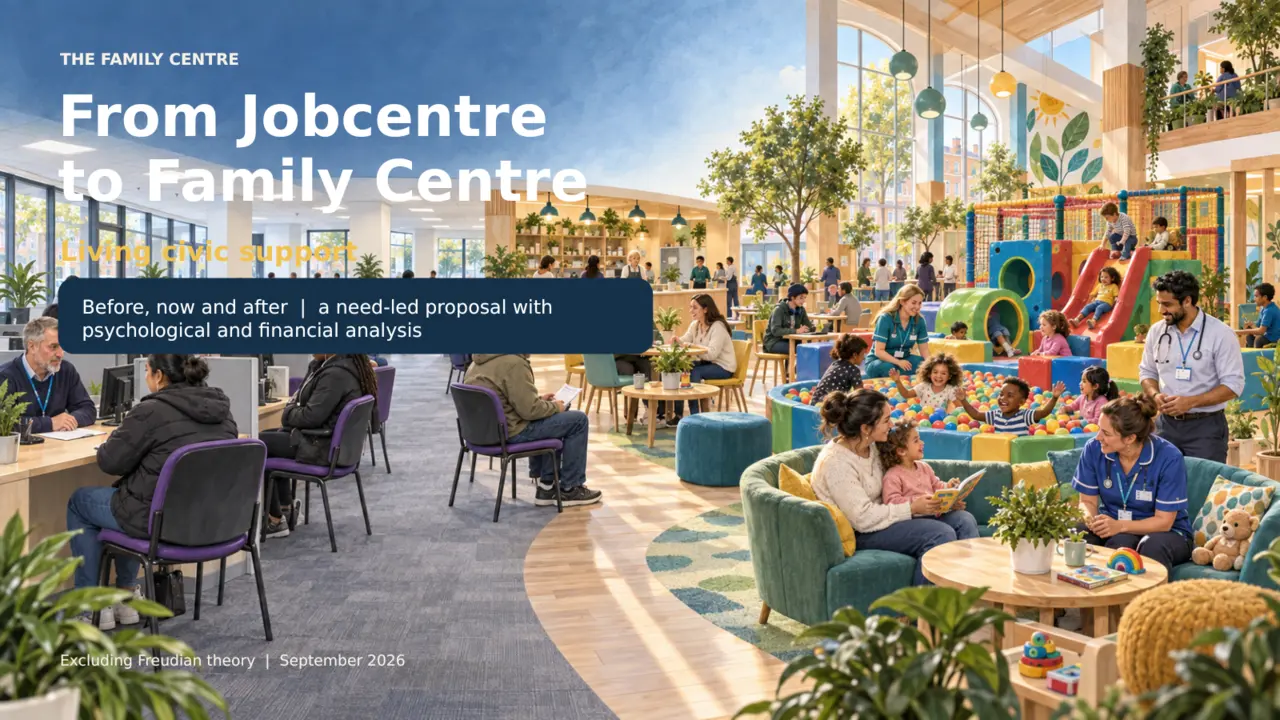
Transformation without abandonment
The proposal does not treat Jobcentre workers as the problem. It recognises that skilled people can be constrained by conflicting duties, narrow measures and systems organised around threat.
Income security changes the encounter. A person can speak honestly without every difficulty becoming evidence against them. Staff can use judgement, time and local knowledge to connect people with help instead of repeatedly testing submission.
“Family” means the relationships a person relies upon: children, partners, friends, carers, chosen family—or nobody currently available. Nobody has to arrive with a conventional household to belong.
Care without paternalism
Essential security cannot depend on pleasing a member of staff or revealing private parts of a life.
Health, care, learning and employment support are offered without turning an offer into a hidden test.
Collect only necessary information and keep voluntary clinical or family disclosure outside sanction decisions.
Independent advocacy, understandable decisions and meaningful appeals keep correction possible.
Clinical governance, accessibility, safeguarding and properly supported staff remain non-negotiable.
Complete presentation · 18 slides
The web viewer loads one compressed slide at a time, so the presentation can be read without first downloading the full PowerPoint. The source file remains available with its citations and methodological notes.
A need-led proposal with psychological and financial analysis. The corrected copy repairs the ONS source link without changing the visible slides.
Download the presentation ↓SHA-256 · aa686d8ec321648aa90771eb3a9f40c5973d61e045725dbc4b8198586db482b3