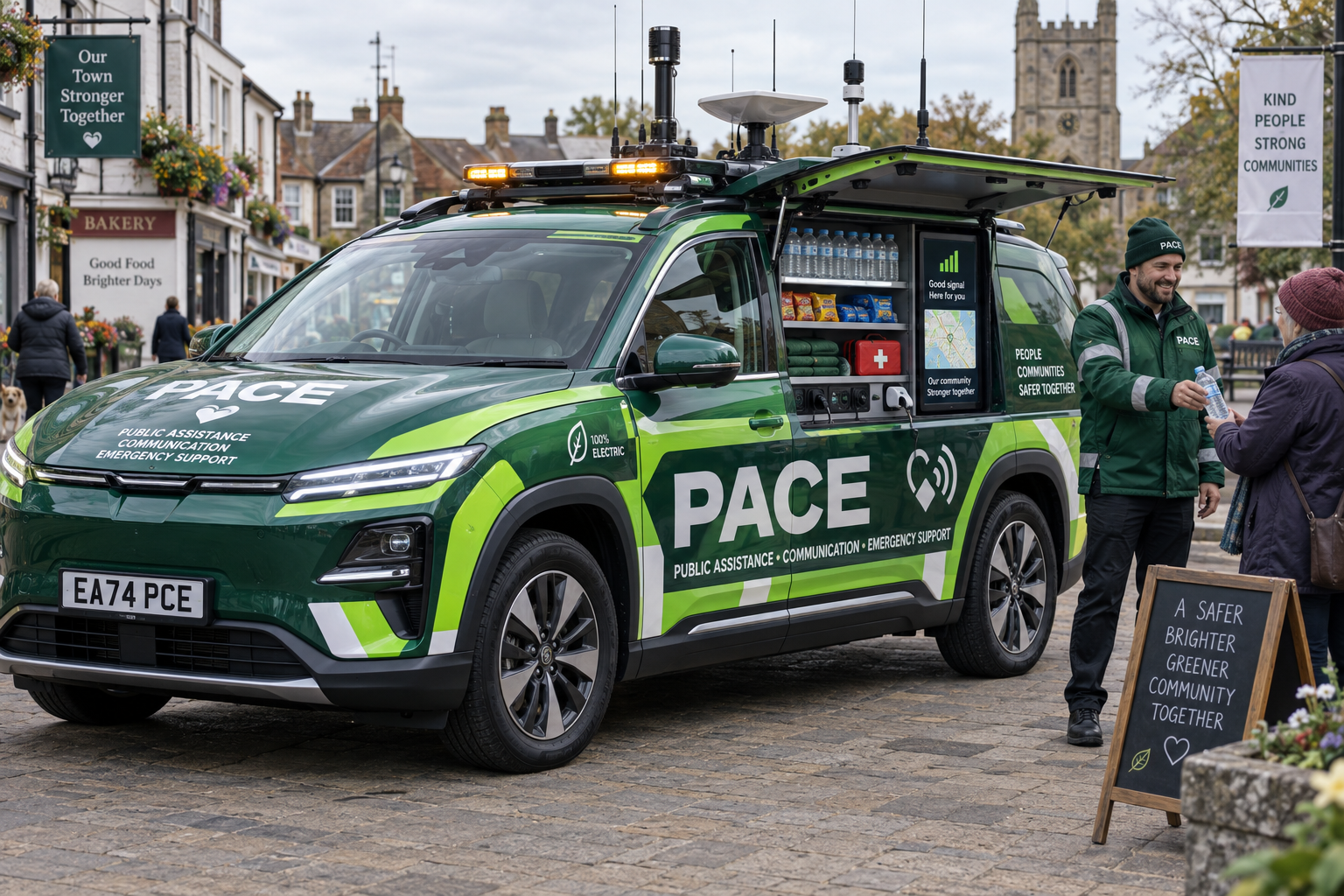
Public Assistance, Communication and Emergency Support
An open proposal for mobile welfare, shared journeys, communications resilience, lawful sensing and a calm road presence—built around practical help, consent, privacy and accountable technology.
Illustrative concept image. Not a final vehicle specification, operational service or indication of government approval. Any deployment would require community participation, legal review, safety testing and independent oversight.
ProposalNot a current public service
CivilianNo police or compulsory powers
Consent-ledHelp without proof of eligibility
Pilot firstTest, inspect and decide before expansion
The question
What if a vehicle arriving in your community did not come to control you, but to help?
This proposal establishes a civilian public service using electric vehicles as mobile welfare points, communications relays, lawful sensor platforms and shared community transport.
PACE vehicles would support the public and emergency responders without exercising police powers. The recommended next step is a controlled local pilot designed with residents, emergency services, highways authorities, network operators and independent oversight.
Concept proposed by AL · 20 September 2026 · United Kingdom
Proposal at a glance
Practical means to help. No general power to control.
Element
Proposed approach
Status
Proposed civilian, government-licensed public service with no coercive or enforcement powers
Operator entry
Three years of licensed driving experience and a short, free role-specific driving assessment
Vehicles
Accessible electric cars and MPVs equipped for welfare, communications, mapping and shared journeys
Community benefit
Free food, drink, charging, connectivity, company and available passenger places
Network role
Distributed emergency communications and coverage support with lawful spectrum awareness
Road role
Predictable lawful driving with a network-governed maximum speed ceiling and no minimum pace requirement
Purpose and service identity
A public-service driver, not a police officer.
PACE stands for Public Assistance Communication and Emergency Support. It is proposed as a national civilian resilience service delivered through a distributed fleet of green vehicles. Each vehicle would provide an immediate local benefit while contributing to a wider emergency network.
PACE operators would be public-service drivers rather than police officers. Their authority would be limited to offering help, operating approved equipment, recording objective public conditions and relaying information to the responsible service.
Police, fire, ambulance, coastguard, highways and defence authorities would retain their existing decision-making and operational responsibilities.
Founding principles
Help begins with need.
Help is available because a person needs it, not because they can prove eligibility.
PACE may offer assistance but cannot stop, search, detain, pursue, penalise or compel anyone.
Operators and passengers participate by consent and may decline an unsuitable or unsafe journey.
Connectivity, food, drink and transport are never conditional on providing personal information or making a donation.
Monitoring concerns road, environmental and network conditions. It does not create authority for indiscriminate interception of private communications.
Every protected system access and transmission is authenticated, proportionate and auditable.
Functions of a PACE vehicle
One vehicle. Several forms of resilience.
Function
What the vehicle provides
Welfare
Water, hot or cold drinks, long-life food, blankets, hygiene supplies, first aid and charging
Shared journeys
Free available seats, accessible transport, companionship and help reaching safe practical destinations
Communications
Emergency Wi-Fi, mobile coverage support, authorised radio, satellite backhaul and store-and-forward messaging
Sensing
Time-stamped road, traffic, environmental, positioning and network-availability information
Emergency support
Verified alerts and resilient communications links to the appropriate authorised service
Road presence
Calm and predictable travel at a safe lawful pace agreed for the route and conditions
Community journeys and companionship
A seat without an eligibility test.
Anyone may ask to join an available PACE journey without explaining or proving why. A place depends only on safe capacity, mutual consent, the planned route and respectful conduct. A passenger may travel quietly, talk, listen to music or volunteer to help. Assistance is not conditional on performing work.
Travel, food, drink and company are free. Donations are optional and confer no privilege. Participation requires mutual consent, safe conduct and willingness to travel peacefully together.
Passenger safeguards
Vehicles used for passenger journeys must have suitable seats, restraints, accessibility equipment, insurance and maintenance records.
The driver controls safe capacity, route changes and whether a journey can continue.
A passenger or operator may end participation at a safe location.
Safeguarding procedures apply to children and adults at risk, with additional checks for roles involving regular unsupervised contact.
A PACE journey complements rather than displaces ambulance transport, licensed patient transport or an emergency evacuation order.
Volunteers and paid staff
Voluntary help. A paid core.
PACE would use a mixed workforce. Paid operators would remain responsible for the vehicle, safety, equipment and records. Paid specialists could provide technical, welfare, accessibility and coordination support. Registered volunteers and spontaneous helpers could assist with simple supervised tasks when conditions allow.
Operator entry and pay
A PACE operator would not need to be a police officer or hold an emergency-service qualification. Entry would require at least three years of licensed driving experience, the correct licence for the assigned vehicle and completion of a short role-specific driving assessment. The assessment and introductory training would be free.
The post would provide regular paid employment at a genuine living wage rather than the statutory minimum. Volunteer labour should not replace the paid core workforce.
Who can contribute
Different roles. Visible boundaries.
Role
Permitted contribution
Boundary
PACE operator
Driving, welfare support, approved communications and incident reporting
No police or compulsory powers
Technical specialist
Vehicle systems, connectivity and sensor maintenance
Access limited to assigned systems
PACE companion
Supplies, company, translation and practical community help
No protected network or personal-record access
Emergency volunteer
Temporary support during outages, floods, severe weather or evacuation
Works within a defined supervised task
Passenger helper
Offers safe assistance during a journey
Help is optional and may stop at any time
Communications and coverage support
A distributed mesh. Not an invisible promise.
PACE vehicles could add temporary capacity where ordinary networks are weak or unavailable and reroute authorised emergency messages when a single route fails. A large fleet would reduce dependence on any one vehicle, but the service should never claim that a vehicle is impossible to locate, disable or attack.
Community connectivity
Authorised neutral-host small cells, Wi-Fi, satellite links and operator agreements could support local access. A coverage radius of about one kilometre or more is a design objective, not a guarantee. Range and capacity depend on terrain, buildings, antenna position, spectrum, power and network approval.
Spectrum and transponder functions
Wideband awareness would measure signal presence, congestion, interference and possible loss of navigation services. It would not permit indiscriminate interception of private messages or calls. Jamming, spoofing and false transponder identities would be prohibited.
Mapping and guidance
Approved sensors could provide time-stamped maps of road hazards, congestion, environmental conditions, network coverage and navigation integrity. Guidance would support safe routes, responder access, evacuation and service coordination—not weapons targeting or autonomous enforcement.
Network layer
Purpose
Access rule
Community layer
Public connectivity, welfare access and non-sensitive service information
Open or ordinary authenticated access
Emergency layer
Priority messaging, verified alerts, routing and resilience for authorised responders
Accredited users and encrypted gateways
Defence boundary
Civil emergency coordination involving military personnel
Separated from tactical command, intelligence and weapons systems
Ordinary PACE cars should not carry tactical military command traffic. They may support military personnel with food, welfare, navigation and civil emergency communications. Keeping operational defence traffic separately identified and controlled protects the civilian character of the fleet and the trust of communities.
Road pace and deployment
Calm presence. No rolling roadblock.
PACE vehicles would use routes and pace ranges agreed through published arrangements with highways authorities and communities. Drivers would travel at the lowest safe and lawful speed appropriate to conditions without creating an unreasonable obstruction.
They would not form rolling roadblocks, pursue vehicles or claim exemptions available to emergency responders. Operators would be requested rather than compelled to accept a specific deployment and could decline because of health, safety, fatigue, competence or suitability.
Network-governed maximum speedA ceiling is not a target.
The electric drivetrain would use authenticated PACE network data to apply a maximum speed ceiling for the vehicle’s current road and operating conditions. The driver remains responsible and may always travel more slowly.
Instructions must be signed, time-limited and location-specific. Changes must be shown before taking effect and applied progressively rather than through sudden braking. Missing, expired or conflicting data must trigger a defined safe fallback and visible warning. A temporary safety override would exist only to avoid an immediate hazard, with the event logged for review.
This system would govern PACE fleet vehicles only. It would not create or alter a legal speed limit for anybody else.
01
Food, drink and essential supplies
Operators would be authorised and funded to give welfare supplies free of charge to members of the public, emergency responders, NHS and voluntary workers, highways and utility crews, and military personnel. No ordinary assistance would require proof of need, payment or explanation.
02
Donations without privilege
The service could accept money and suitable supplies through transparent arrangements. Donations would remain optional, buy no priority or influence, and be publicly accounted for. Cash handling should be minimised where practical without excluding people who can donate only in cash.
03
Music by agreement
Music may be played inside when the driver and passengers agree. It must remain quiet enough for traffic, warnings and emergency communications to be heard. Anyone may request silence or lower volume, and operational messages always take priority.
Vehicle and energy design
The equipment serves the human space.
Design area
Proposed requirement
Energy
Battery-electric propulsion using renewable electricity contracts, with reserve power for essential communications
Accessibility
Step-free or ramp access where the vehicle class permits, wheelchair space and accessible controls
Safety identity
Distinct green civilian livery, amber warning lights and no resemblance to police or military vehicles
Speed governance
Electric-drivetrain ceiling set by authenticated, location-specific PACE network data while allowing any lower safe speed
Modularity
Different vehicle types for connectivity, welfare, accessible journeys and major-incident support
Resilience
Local energy storage, vehicle-to-load power, replaceable communications modules and offline procedures
Human space
Comfortable passenger seating separated safely from equipment and supplies
Privacy, accountability and public trust
Public infrastructure, not an unaccountable surveillance fleet.
PACE depends on visible rules, limited purposes and independent inspection. The service should publish equipment categories, data fields, retention periods, access roles, incident logs and aggregate performance without exposing personal or protected operational information.
Collect only data needed for a defined safety, network or welfare purpose.
Do not use facial recognition or covert individual tracking as an ordinary PACE function.
Do not require passengers or welfare recipients to identify themselves unless a separate legal and safety requirement applies.
Encrypt protected data in transit and at rest, and keep civilian, emergency and defence systems separated.
Record protected access and transmissions in tamper-evident audit logs.
Provide an accessible written complaints process and independent investigation route.
Require explicit legal authorisation and public scrutiny before adding any coercive or intrusive capability.
Main risks and controls
Risk
Required control
PACE appears to be policing
Civilian livery, no blue lights, no enforcement powers and clear public operating rules
Private communications are intercepted
Spectrum measurements exclude content collection unless separately and lawfully authorised
Civilian vehicles become military assets
Exclude tactical military command, intelligence and weapons traffic from ordinary PACE vehicles
Slow driving creates danger
Route-specific safe-pace policy, driver training and a prohibition on deliberate obstruction
Incorrect speed data creates danger
Signed time-limited instructions, advance warning, progressive limiting, defined fallback and logged safety override
Passengers or volunteers are harmed
Suitable insurance, safeguarding, seat capacity, supervision, check-in and incident procedures
Donations influence service
Optional donations, no donor priority and published accounts
Coverage claims exceed performance
Publish measured coverage and describe one kilometre as an objective, not a promise
Proposed pilot
Begin parked. Expand only through evidence.
A pilot should test the service before national legislation or procurement. It should include an urban neighbourhood, a rural area with weak coverage and a transport corridor. Residents and frontline services should help select routes, operating hours, welfare stock and privacy controls.
Stage
Work
Design
Agree governance, service boundaries, vehicle classes, safety cases and community oversight
Static trial
Test welfare provision, charging, connectivity and public access while vehicles remain parked
Limited routes
Run published routes with trained operators and restricted sensor functions
Emergency exercise
Test network loss, store-and-forward messages and coordination with authorised responders
Independent review
Evaluate safety, privacy, public trust, coverage, cost and operational usefulness before expansion
Measures for evaluation
01
Vehicle and communications availability, including recovery after an outage.
02
Measured changes in usable mobile coverage and capacity around deployed vehicles.
03
Number and type of welfare interventions recorded without unnecessary personal data.
04
Passenger and operator safety reports, accessibility outcomes and service feedback.
05
Accuracy and usefulness of verified road, environmental and network alerts.
06
Traffic effects on agreed routes, including evidence of obstruction or unsafe overtaking.
07
Accuracy, availability and safe operation of network speed ceilings, including fallback and override events.
08
Energy use, renewable-electricity share, maintenance requirements and total operating cost.
09
Complaints, data-access events and independent audit findings.
Decision requested
Examine whether a locally governed pilot should proceed.
The proposal asks public authorities, emergency services, network operators, community organisations and residents to examine a PACE pilot. Approval should depend on a published safety case, communications licensing, insurance, accessibility, safeguarding, data protection, procurement and independent oversight.
PACE has the practical means to help but no general power to control people.
Its value should be judged by safer roads, stronger communications, useful emergency information and direct assistance delivered with consent.