Repair and reuse
Retain the useful item or component when possible. This is the first route before heat, shredding or re-forming.
Climate Change Technology · P—54 · 10 October 2026
Propose a workshop where suitable materials are identified, reused or made into useful products, with a public record of each batch and its destination.
Start with a small, measurable job. Let the products, costs and material balance show whether a wider local network is justified.
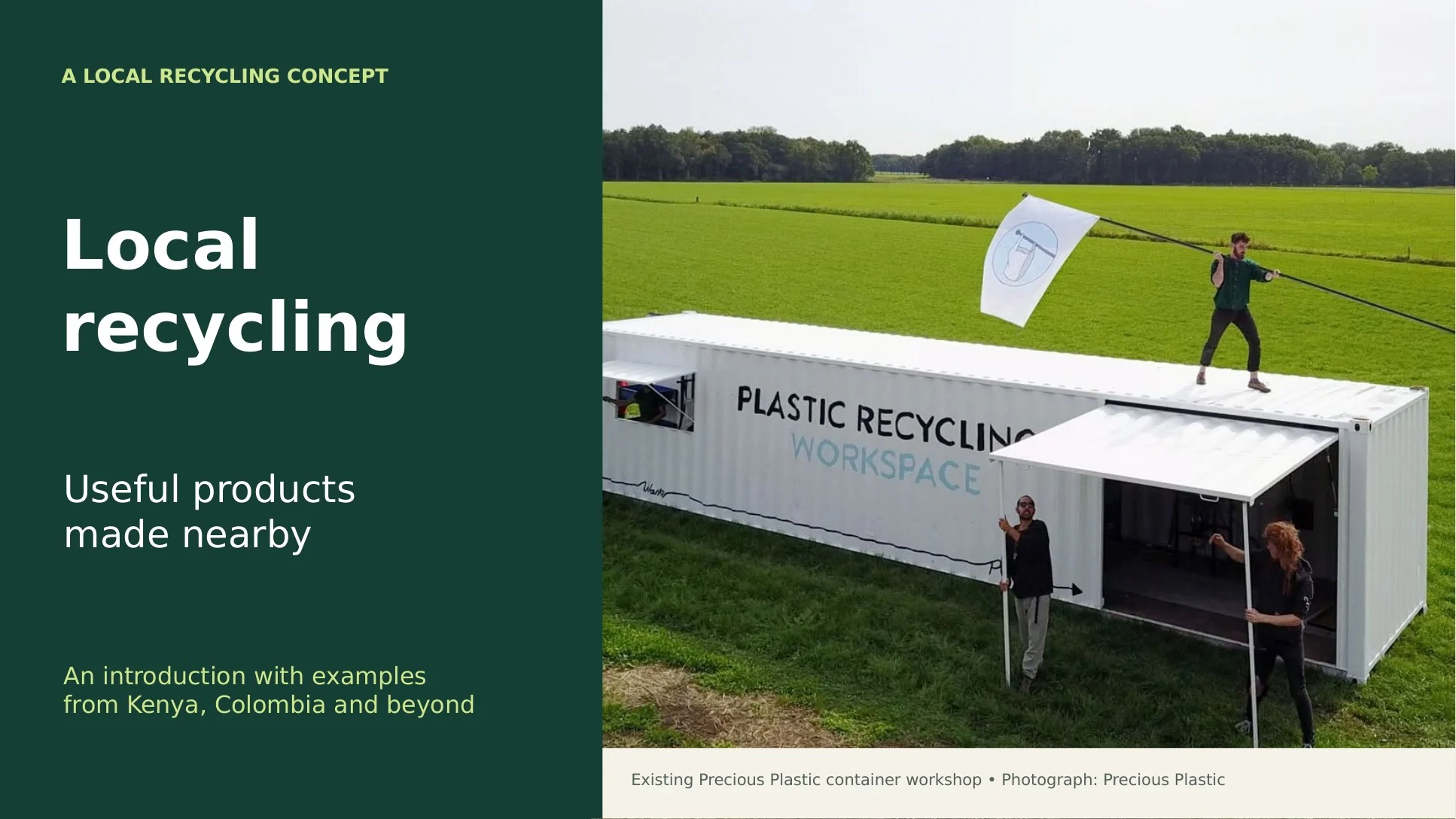
Watch the nine-slide introduction ↓The complete introduction · slide 1 of 9
How the proposal works
A finished object demonstrates what happened to one batch; it does not establish that every item collected was recycled.
Weigh a batch, record its source, identify the material and reject or quarantine anything unsuitable. Repair and direct reuse come first.
Use a controlled recipe for a suitable, known material. The starter uses prepared clean plastic feed for small moulded products; metal work has a separate dry bay and its own checks.
Record output, rejects and inspection. Test a product for its intended use before offering it for sale. Structural building products need their own validation and approval.
Publish incoming mass, products, stock, residues and specialist transfers, alongside energy, transport, paid hours, prices and corrections.
A route for the material
The paper distinguishes recovery methods, equipment, product testing and specialist routes. A long list of named materials is a starting point for investigation, not a promise to recycle them all on site.
Retain the useful item or component when possible. This is the first route before heat, shredding or re-forming.
Sort by identity and recipe, remove unsuitable parts, clean and dry where required, then mould or extrude only within the equipment and quality limits. The starter buys prepared feed.
Keep alloys separate, verify composition and product requirements, measure charge and dross. A small furnace can cast selected material; melting alone does not refine an unknown alloy.
Quarantine or refuse unknown and unsuitable feed. Use documented specialist routes for materials that cannot safely or economically be handled by this workshop.
Search the accompanying inventory
The first-stage index has 111 polymer records and 97 metal and associated-material records. Family, subtype and grade entries can overlap. It also supplies 29 name mappings and 50 sources. These are records of identity and UK offer evidence, not measured UK stock, available batch quantities or approved workshop recipes.
Showing 18 of 208 matching records
Polyolefins · UK offer
Polyolefins · UK offer
Polyolefins · UK offer
Polyolefins · UK offer
Polyolefins · Reference only
Polyolefins · Reference only
Polyolefins · UK offer
Polyolefins · UK offer
Polyolefins · Reference only
Polyolefins · UK offer
Ethylene copolymers · UK offer
Ethylene copolymers · UK offer
Styrenics · UK offer
Styrenics · UK offer
Styrenics · Reference only
Styrenics · UK offer
Styrenics · UK offer
Styrenics · UK offer
For the full fields, source references and naming notes, use the spreadsheet or JSON inventory below.
A bounded first pilot
The workshop design keeps plastic preparation and metal trials separate. The first option uses prepared clean plastic feed for small moulded items; it does not establish capacity for building blocks or a complete mixed-waste plant.
Planning estimates include allowances for contingency and VAT, but exclude site, wages, permissions and other operating needs. These figures are not supplier quotations or complete opening costs. HHO is a separate unproven option, not an assumed energy saving.
Public proof
A public material ledger should reconcile opening stock and receipts with dispatched products, external transfers, residues, process losses and closing stock. A batch label can state its material, inspection, intended use and return route.
Compare actual electricity, transport, yield and product lifetime against a real alternative before claiming carbon savings. The paper’s numerical carbon and transport examples are planning scenarios; its favourable local product case is small, while other assumed cases perform worse.
Log paid hours, product sales, costs, customer demand and corrections too. These measures help decide whether a pilot merits expansion.
Original files · eight downloads
The browser presentation preserves all nine slides. The original PPTX retains its speaker notes and source URLs. The paper, pilot design, report and inventories remain available in their supplied formats.